Does your child really understand math just by watching video lectures?
Hello to all the academy directors, and to the teachers who meet students every day. Haven't you been getting more and more questions from parents about online remote academies lately? Middle school math in particular is a subject with many requests to move online, but when it comes to actually adopting it, you may be wondering, "Are video lectures alone enough?"
In middle school math, there is quite a big gap between understanding a concept and applying it to problems. Recorded video lectures are effective for explaining concepts, but they have a limitation: there is no way to know where a child actually gets stuck when solving problems. Today, focusing on this point, we'll go through why an online remote academy needs live classes, and what parents should check when choosing an online remote academy.
The limits of watching videos alone, and why they show up more in middle school math
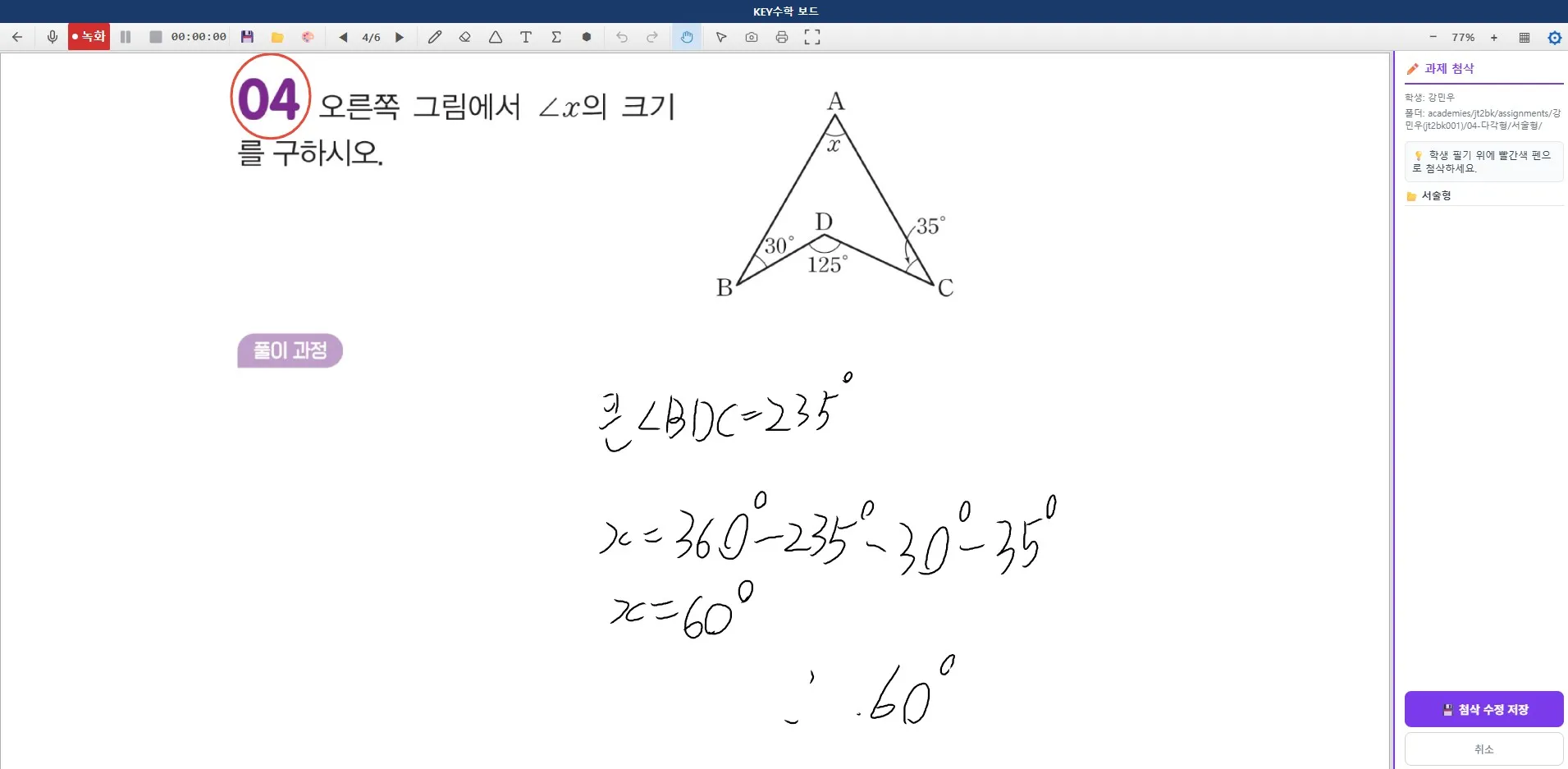
Unlike elementary arithmetic, in middle school math the solution process is the skill itself. It is common for a student to get the right answer with an inefficient method, or to apply a concept incorrectly midway and still land on the right answer by chance. You can only find these problems when the student shows the solution process and the teacher points them out on the spot.
In online academies built around recorded lectures, this kind of feedback tends to be structurally missing. When a child watches a video and gets stuck solving problems alone, the error from that moment often carries over into the next unit. In a live class, on the other hand, the teacher can watch the solution process on screen and give feedback right away, so the sticking point can be caught immediately.
3 reasons live classes work well for middle school math
Real-time check of the solution process - The teacher can look at the student's notes right away and point out where the concept was misunderstood.
Instant questions and answers - Without having to replay a recording, students can ask a question the moment they get stuck and hear the answer.
Building study habits - Logging in at a set time and taking part in class itself creates a steady study rhythm.
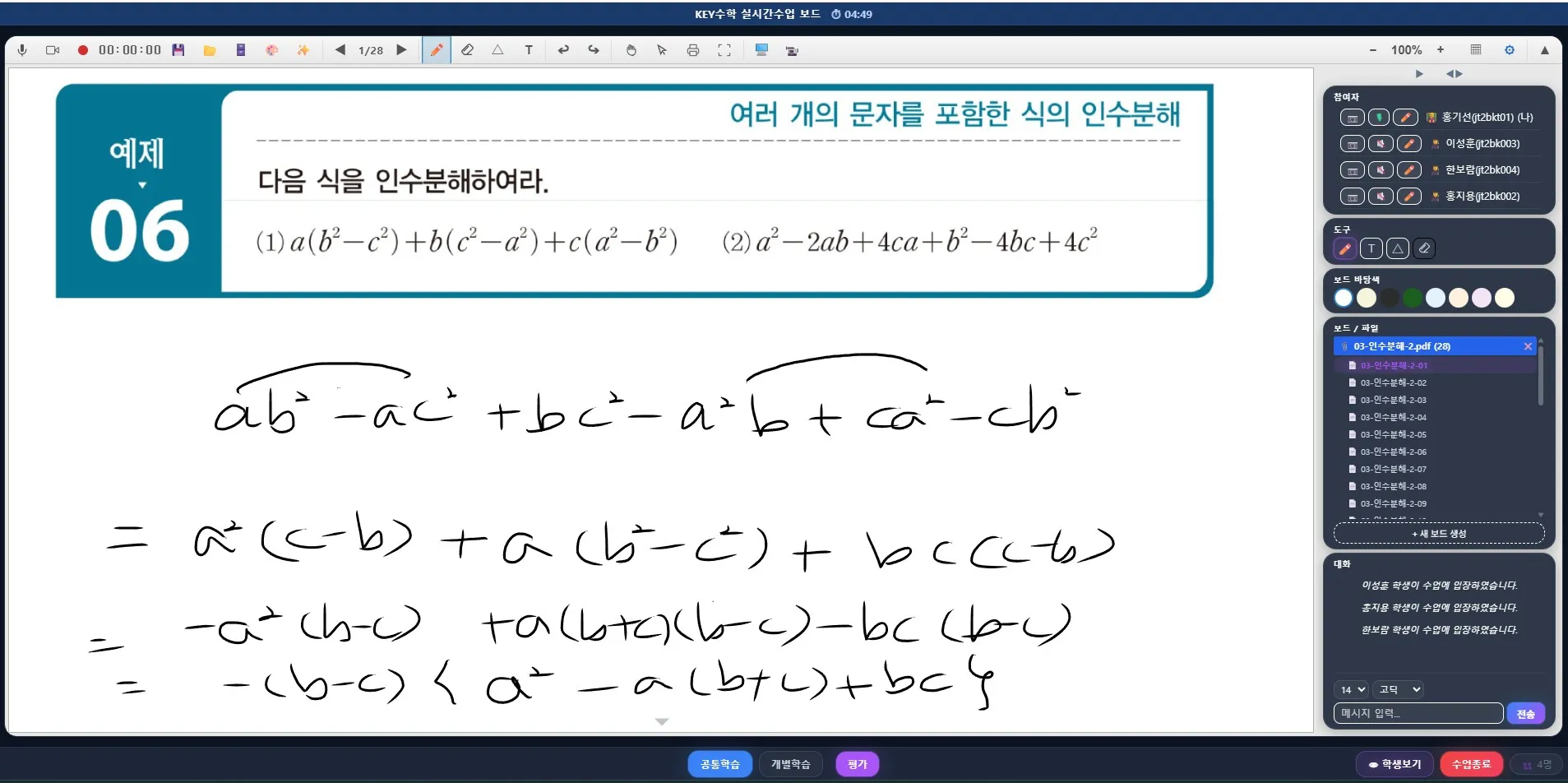
The ClassCanvas live class program supports a one board per student setup to meet these needs. When each student solves problems on their own board, the teacher can watch everyone through screen share, then look at one student at a time in individual mode and give one-on-one feedback. This structure is especially well suited to subjects like middle school math, where checking the solution process is important.
What parents should check when choosing an online remote academy
We've put together a list of items for parents to check when looking into an online remote academy. Knowing them before a consultation will help you choose an academy.
Share of live classes - First check whether the academy is built around recorded lectures or includes live classes.
Feedback method - Ask whether the teacher looks at the solution process directly and gives feedback, or only grades the results.
Class size - Whether one-on-one feedback is actually possible depends on how many students are in a class.
Platform stability - It is also important that the online lecture platform runs reliably without connection drops.
Attendance and assignment management - To build steady study habits, it helps to check that attendance and assignments are managed systematically.
Things you can try right at home
Apart from choosing an academy, there are also ways to check your child's math learning at home.
Ask your child to explain in their own words the concept they learned today. If the explanation stalls, it's a sign the understanding is incomplete.
Have your child rewrite the solution process for a problem they got wrong. You'll be able to see at which step they got stuck.
After a live class, casually ask about the questions they asked that day. The fact that your child asked a question on their own means they are taking an active part.
Whether the academy is an online remote academy or an offline one, doing these checks consistently at home is a big help in understanding your child's learning.
Points for academy operators to consider
For directors, explaining these points to parents first when running an online remote academy helps build trust. Rather than just saying "Online classes are available," being specific, such as "We watch the solution process in real time and give one-on-one feedback," will ease many of parents' worries.
Also, when you set up a new online remote academy or add an online course to an existing academy, you need to take care of the registration process for a remote tutoring academy and prepare the related documents. Requirements may differ slightly by local office of education, so it's safest to check in advance.
ClassCanvas has the features needed to run live middle school math classes like these, so it can be a useful reference for directors preparing an online remote academy or looking to improve how they currently operate. Checking each student's solution process with one board per student, guiding students by level in individual mode, and moving between whole-class explanation and one-on-one feedback with screen share is a structure that suits subjects like middle school math, where process-focused feedback matters.
Wrapping up
In middle school math, why you solved a problem a certain way matters more than getting the answer right. Video lectures alone can easily miss this, so when considering an online remote academy, be sure to check whether live classes are included and whether one-on-one feedback actually happens.
Parents can check their child's understanding with just a few simple questions at home, so give today's checklist a try. And for directors who run an academy or are thinking about moving to an online remote academy, it may also be a useful reference to look at how ClassCanvas's live class approach can help with teaching middle school math.
ClassCanvas learning management system
Steps to set up a remote academy
Customer support 1661-9155 (Korean only)
ClassCanvas, the total solution for online remote academies